How People Lived in Ancient China | Part 3
No electric light:
how did people spend the night?
In short: Most families went to bed when it got dark, because light at night cost money: lamp oil and candles were not cheap. Poor children who wanted to study bored holes in the wall to borrow a neighbor's light, or caught fireflies to read by; wealthy households used cleverly designed bronze lamps. In Tang-dynasty Chang'an, the ward gates closed as soon as it got dark. It was only in the Northern Song that the night markets of Bianjing stayed open until the third watch, and the liveliest spots never stopped all night. Lu You even described a lamp you filled with cold water that burned about half the oil.
Someone who couldn't sleep watched the courtyard fire all night
What did someone who couldn't sleep see, more than two thousand years ago? In the “Lesser Odes” of the Book of Songs there's a poem called “The Courtyard Torches,” and it opens with someone asking a question in the middle of the night:
「夜如何其?夜未央,庭燎之光。」
How goes the night? The night is not yet half over — there is the light of the courtyard torches.
Book of Songs (詩經), “Lesser Odes: The Courtyard Torches” (小雅・庭燎)
What time of night is it now? The night isn't even half over. The “courtyard torches” were big torches lit in the courtyard. All three stanzas of the poem open with the same question, and the answer goes from ye wei yang (not yet half over), to ye wei ai (not yet at its end), to ye xiang chen (almost morning). This person woke up several times over one night, and every time they looked outside, there was that same fire in the courtyard, burning from bright to nearly out — and then it was almost dawn.
Lighting up a whole night took a pile of fire that someone kept tending the entire time. That was not something an ordinary household could afford to burn.
“Boring through the wall” and “the bag of fireflies” are both about how costly light was
What are the stories of “boring through the wall” and “the bag of fireflies” really about? Ordinary families went to sleep when it got dark, but people who wanted to study weren't willing to give up. Here is how the books describe Kuang Heng of the Han dynasty:
「匡衡字稚圭,勤學而無燭。鄰舍有燭而不逮,衡乃穿壁引其光,以書映光而讀之。」
Kuang Heng, styled Zhigui, studied hard but had no candles. His neighbor had candles, but their light did not reach him, so Heng bored through the wall to let the light in, and read his books by the light that shone through.
Miscellaneous Records of the Western Capital (西京雜記), Vol. 2
He worked very hard, but there were no candles at home. His neighbor had them, but the light didn't reach his house, so he dug a hole in the wall and held his book up to that little bit of light to read. That's where the saying “boring through the wall to steal the light” comes from.
Che Yin of the Jin dynasty was the same:
「家貧不常得油,夏月則練囊盛數十螢火以照書,以夜繼日焉。」
His family was poor and could not always get lamp oil. In the summer months he filled a bag of white silk with a few dozen fireflies to light his books, carrying the day on into the night.
Book of Jin (晉書), Vol. 83, “Biography of Che Yin” (車胤傳)
His family was poor, and they often couldn't afford lamp oil. So in summer he made a bag out of white silk, put a few dozen fireflies in it to light up his book, and whatever he couldn't finish reading during the day, he kept reading at night. We've heard both of these stories since we were children, and what we were meant to hear was how hard they worked. Look at them from another angle, though, and they're really saying the same thing: back then, a little light at night was so expensive that poor children had to dig through walls and catch insects to get it.
A single candle was a gift handed out by the palace
How expensive were candles? The Tang poet Han Hong wrote a poem called “Cold Food Festival.” By custom, no household lit a fire on that festival, and then, as evening fell:
「日暮漢宮傳蠟燭,輕煙散入五侯家。」
At dusk, lit candles are passed out from the Han palace, and their light smoke drifts into the homes of the five marquises.
Han Hong, “Cold Food Festival” (韓翃〈寒食〉)
When it got dark, the palace passed out lit candles one by one, and the thin smoke drifted into the homes of the princes and nobles. The poem says “the Han palace,” but it's really describing the poet's own time: while the whole city was still dark, the first houses to light up were those of the rich and powerful. In this poem, a single candle is a royal gift.
The two-thousand-year-old Changxin Palace Lamp swallowed its own smoke
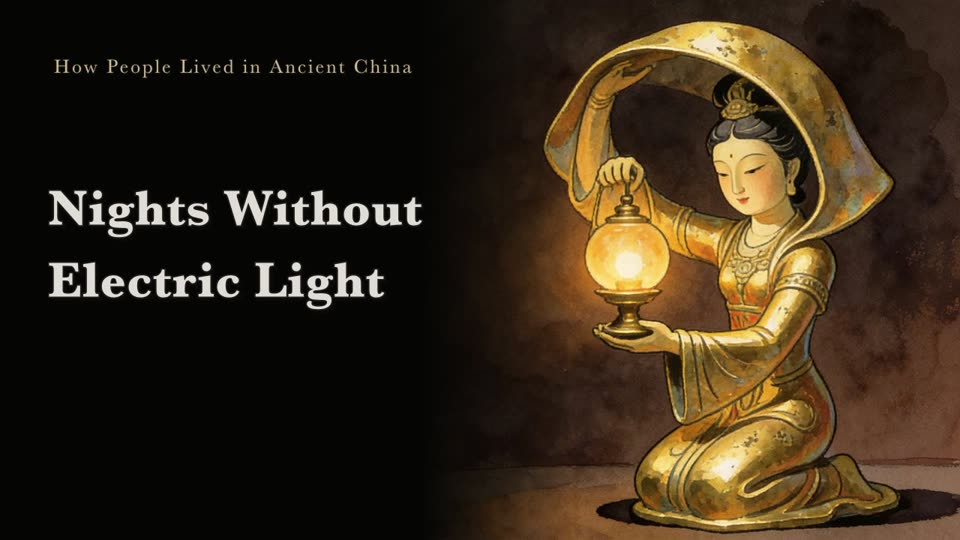
A lamp from two thousand years ago that cleared its own smoke? In 1968, a bronze lamp was dug up from a Western Han tomb in Mancheng, Hebei. Because the word “Changxin” is engraved on it, it later became known as the Changxin Palace Lamp, and today it is in the collection of the Hebei Museum.
It is a kneeling palace maid. Her left hand holds up the lamp, and her right arm is raised, with the sleeve hanging down so that it covers the lamp exactly. That sleeve is hollow: when the lamp is lit, the smoke travels up the sleeve and into her body instead of drifting all over the room. Around the lamp there are also two bronze panels that slide: push them left or right and the light shines in a different direction; open them wider or close them down and the brightness changes too.
You can aim it, you can dim it, and it even swallows its own smoke — which is more or less what the lamp on your desk does, too.
“Trimming the candle” means cutting off the burnt wick
What does “trimming the candle” mean? Li Shangyin's poem “Night Rain: A Letter to the North” has a famous line:
「何當共剪西窗燭,卻話巴山夜雨時。」
When will we trim the candle together by the west window, and talk again of this night's rain in the Ba hills?
Li Shangyin, “Night Rain: A Letter to the North” (李商隱〈夜雨寄北〉)
When will we finally sit together under the west window, trimming the candle, and talk about the rain falling tonight in the Ba hills? In the old days, when a candle had burned for a while, the wick grew long and curled into a lump; the flame grew dim and started to smoke, and someone had to take scissors and snip off the burnt part for the light to come back. For two people to talk until the candle needs trimming means they've talked for a very, very long time — the longing in this line is measured in the time it takes a candle to burn.
In Tang Chang'an, the gates shut after eight hundred drumbeats
Why couldn't people in the Tang dynasty just go out at night? Even if you had a lamp, nights in Tang-dynasty Chang'an had one more barrier — a gate:
「日暮,鼓八百聲而門閉。」
At dusk, the drums sound eight hundred times and the gates close.
New Book of Tang (新唐書), Vol. 49A, “Treatise on Officials” (百官志)
When the sun went down, the drums were struck eight hundred times, and the gate of every residential ward closed. After the gates shut, you could walk around inside your own ward, but you couldn't just wander out onto the main streets. For the people of Chang'an, night wasn't only dark. At night, you were locked in.
Song night markets stayed open until the third watch and opened again at the fifth
That changed in the Northern Song. How late did Song-dynasty night markets stay open? Here is Meng Yuanlao writing about Bianjing (today's Kaifeng):
「夜市直至三更盡,才五更又復開張。如要鬧去處,通曉不絕。」
The night market runs right through to the end of the third watch, and as soon as the fifth watch comes it opens again. As for the liveliest places, they go on until dawn without a break.
Meng Yuanlao, Dreams of Splendor of the Eastern Capital (東京夢華錄), Vol. 3
(The night was divided into five “watches.”) The night market stayed open until the third watch was over, and by the fifth watch it was already open again — the only gap was the fourth watch, roughly two hours. In the busiest places it never stopped all night. He also writes that at the third watch, people carrying jugs and selling tea would appear on the streets, “because the people of the capital, busy with public and private affairs, only come home late at night.” In the capital, people out on official business or their own errands didn't get home until late. In a city more than nine hundred years ago, there were already people working until midnight, and people at the roadside selling them a hot cup of something.
An oil-saving lamp from over eight hundred years ago held cold water in its double wall
What did an oil-saving lamp look like, more than eight hundred years ago? In Notes from the Old Learning Hermitage, Lu You of the Southern Song described the “oil-saving lamp dishes” of the Hanjia area: the lamp dish was made with a double wall, hollow in the middle.
「一端作小竅,注清冷水於其中,每夕一易之。尋常盞為火所灼而燥,故速乾,此獨不然,其省油幾半。」
A small hole is made at one end, and clear cold water is poured into it, to be changed once every evening. An ordinary lamp dish is scorched by the flame and grows dry, so the oil dries up quickly; this one alone does not, and it saves nearly half the oil.
Lu You, Notes from the Old Learning Hermitage (陸游《老學庵筆記》), Vol. 10
You made a small hole on one side, poured cold water into the hollow wall, and changed the water once every evening. An ordinary lamp dish gets very hot from the flame, and the oil dries up fast; this one has water inside cooling it down, so it uses almost half as much oil. Using cold water to cool a lamp so the oil burns more slowly — that was energy-saving design, more than eight hundred years ago.
On the nights of the Lantern Festival, the whole city was lit
Which nights of the year was the whole city lit up? Most of the time people saved, but during the Lantern Festival they didn't save at all. Dreams of Splendor of the Eastern Capital says that after the winter solstice, Kaifeng Prefecture built a towering “lantern mountain” in front of the imperial palace, facing the Xuande Gate Tower. When the first month came, the frame was hung all over with colorful lanterns:
「燈山上彩,金碧相射,錦繡交輝。」
The lantern mountain is hung with color; gold and green shine upon each other, and brocade and embroidery glitter together.
Meng Yuanlao, Dreams of Splendor of the Eastern Capital (東京夢華錄), Vol. 6, “The Lantern Festival” (元宵)
Gold and green light shone back and forth, sparkling and crisscrossing like brocade; the music in the streets was “a din for more than ten li,” loud enough to hear miles away. For someone who normally went to bed when it got dark and had to count the cost of oil every time they lit a lamp, there were a few nights a year when the whole city was as bright as day, and you could keep walking until dawn.
“Only the prefect may set fires” comes from a Lantern Festival notice
Where does “only the prefect may set fires” come from? Lu You also recorded a very funny story connected to the Lantern Festival. There was a local official named Tian Deng who couldn't stand hearing anyone say his name — not even a word that sounded the same. Anyone who said it got beaten. So nobody in the whole prefecture dared say the word for “lamp” (which sounds like Deng), and they had to call lamps “fire” instead. When the Lantern Festival came and lanterns were to be lit for three days as usual, the officials writing the public notice didn't dare write “lamp,” so the notice that went up read:
「本州依例放火三日。」
In keeping with custom, this prefecture will set fires for three days.
Lu You, Notes from the Old Learning Hermitage (陸游《老學庵筆記》), Vol. 5
“As usual, this prefecture will be setting fires for three days.” Today, when we say “the prefect may set fires, but the common people may not even light a lamp,” this is where it comes from. Even this saying, used to complain about double standards, has a night of lighting lamps behind it.
Now, a press of a switch brings light
For a very, very long time, a little light at night was a fire in the courtyard that someone kept tending, a small hole in a wall, a few dozen fireflies in a bag, a lamp you had to fill with cold water. Every bit of light was there because someone had found a way to keep it. Now all you have to do is press a switch. For us, darkness is no longer something we can't do anything about. It has become something we can choose.
Which parts shouldn't you take as certain?
- Kuang Heng boring through the wall and Che Yin's bag of fireflies are what the books record. Miscellaneous Records of the Western Capital is a collection of anecdotes and tales; the Book of Jin was compiled in the Tang dynasty, about three hundred years after Che Yin.
- The traditional reading of “The Courtyard Torches” (the Mao Preface) is that King Xuan of Zhou, afraid of being late for morning court, asked the time several times in one night; here we use a reading closer to everyday life.
- “Trimming the candle” means cutting off the burnt wick. This is the usual explanation; we don't quote a separate original text for it here.
- The story of Tian Deng is the version Lu You recorded; earlier accounts (Cai Tao's Collected Talks from Tiewei Mountain and Zhuang Chuo's Chicken Ribs Collection) tell it slightly differently.
- The name of the Changxin Palace Lamp comes from the inscription Changxin shangyu on the lamp; the illustration is only an impression, so please see the museum's public materials for the real object.
- “The fourth watch was roughly two hours” is a rough estimate that divides the night evenly into five watches; in ancient times the length of a watch was not exactly the same in every season.
Sources
- Book of Songs (詩經), “Lesser Odes: The Courtyard Torches” (小雅・庭燎) (Chinese Wikisource / 維基文庫)
- Miscellaneous Records of the Western Capital (西京雜記), Vol. 2 (維基文庫)
- Book of Jin (晉書), Vol. 83, “Biography of Che Yin” (車胤傳) (維基文庫)
- Han Hong, “Cold Food Festival” (韓翃〈寒食〉) (維基文庫, Complete Tang Poems 全唐詩)
- Changxin Palace Lamp (長信宮燈): excavated in 1968 from a Western Han tomb in Mancheng, Hebei; in the collection of the Hebei Museum (河北博物院)
- Li Shangyin, “Night Rain: A Letter to the North” (李商隱〈夜雨寄北〉) (維基文庫, Complete Tang Poems 全唐詩)
- New Book of Tang (新唐書), Vol. 49A, “Treatise on Officials” (百官志) (維基文庫)
- Meng Yuanlao, Dreams of Splendor of the Eastern Capital (東京夢華錄), Vol. 3 and Vol. 6, “The Lantern Festival” (元宵) (維基文庫)
- Lu You, Notes from the Old Learning Hermitage (老學庵筆記), Vol. 5 and Vol. 10 (維基文庫)