How People Lived in Ancient China | Part 2
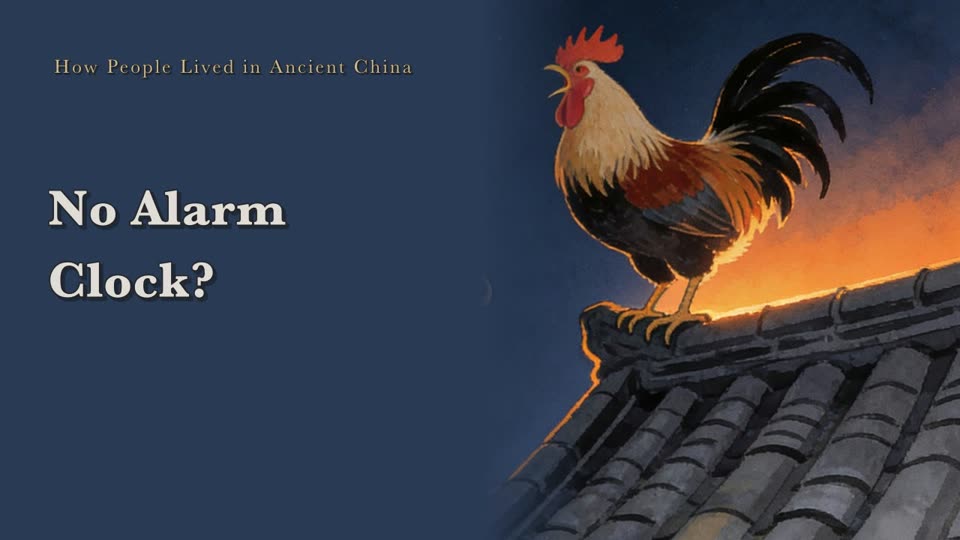
No alarm clocks —
how did people in ancient China wake up on time?
In short: At first, it was the rooster. For court and for ceremonies, there were officials whose job was to watch the water clock and keep track of the time, and officials whose job was to call out as dawn approached and get all the other officials out of bed. By the Tang dynasty, every day before sunrise, drums in Chang'an started up inside the palace and the beat was passed along street after street — three thousand beats in all. In Northern Song Bianjing, temple attendants went from door to door striking wooden fish to announce the dawn.
Someone in the Book of Songs is already staying in bed
Did people two thousand years ago stay in bed too? They did. Among the “Odes of Qi” in the Book of Songs there's a poem called “The Cock Crows,” and it begins:
「雞既鳴矣,朝既盈矣。匪雞則鳴,蒼蠅之聲。」
“The rooster has crowed; the court is already full.” “That's no rooster crowing — it's the buzzing of flies.”
Book of Songs (詩經), “Odes of Qi: The Cock Crows” (齊風・雞鳴)
The rooster has crowed, and everyone's already at court. No, that's not a rooster, that's the sound of flies. The second stanza does it all over again: “The east is bright; the court is in full session.” “It isn't the east growing bright — it's the light of the rising moon.” The sky's getting light in the east? No, that's not dawn, that's moonlight.
Scholars in ancient times read this poem as a reminder to the ruler to get up early for court. Many people today read it another way, as a conversation between two people: one says it's time to get up, and the other stays under the covers making excuses. Whichever way you read it, you can see that back then, the one waking people up was the rooster.
The palace had an official just for waking people: the rooster man
Was there an official whose job was waking people up? Yes. Roosters crow, but not on schedule, and they don't know which days matter. At an important ceremony not a single official could be late, so the Rites of Zhou records a post called the jiren, the “rooster man”:
「大祭祀,夜呼旦以叫百官。」
At the great sacrifices, he calls out the dawn in the night to rouse all the officials.
Rites of Zhou (周禮), “Offices of Spring: The Rooster Man” (春官宗伯・雞人)
Whenever there was a major ceremony, his job was to announce loudly in the night that dawn was near and get every official up. His staff was “one junior officer, one scribe, four attendants” — one person in charge, one keeping records, and four helpers. Whether the whole court started on time came down to these few people not oversleeping.
According to the commentary of the Eastern Han scholar Zheng Xuan, the moment he called out was “when the night's water clock has not yet run out, at the hour the rooster crows”: while the water clock was still dripping through the night, just as the roosters were about to crow.
On nights without clocks, they read the water in a pot
Without clocks, how did people know the time at night? With water. Another post in the Rites of Zhou was called the qiehushi — qie means to carry, so roughly “the one who carries the pot.” Water was put in a pot with a small hole in the bottom, and it dripped out drop by drop; by how much water was left, you could tell how much time had passed. This device later came to be called a water clock.
「皆以水火守之,分以日夜。及冬,則以火爨鼎水而沸之,而沃之。」
In every case they keep watch over it with water and fire, dividing day from night. When winter comes, they heat the water in a cauldron over fire until it boils, and pour it in.
Rites of Zhou (周禮), “Offices of Summer: The Water-Clock Keeper” (夏官司馬・挈壺氏)
By day they read the water level; at night they lit a fire to see the markings — someone kept watch day and night. In winter they even had to boil the water in a cauldron before pouring it in. The commentary is blunt about why: “in winter the water freezes and the clock won't drip.” Once the water froze, it stopped dripping, and time stopped. So on the coldest nights, someone had to keep boiling water to keep time moving forward.
Tang Chang'an: the ward gates opened only when the street drums sounded
How did people in Tang-dynasty Chang'an get up in the morning? Tang Chang'an was divided into a grid of residential wards called fang, each with its own walls and gates, which were shut at night. The New Book of Tang records the rules for opening and closing them. In the evening: “at dusk, the drums sound eight hundred times and the gates close.” And in the morning:
「五更二點,鼓自內發,諸街鼓承振,坊市門皆啟,鼓三千撾,辨色而止。」
At the second point of the fifth watch, the drums sound from within the palace, and the drums of every street take up the beat; the gates of all the wards and markets open. The drums are struck three thousand times, and stop when colors can be told apart.
New Book of Tang (新唐書), Vol. 49A, “Treatise on Officials 4A” (百官志四上)
Before it was light, the drumming started inside the palace, then the drums on each main street took it up one after another, and every ward gate and market gate swung open. Three thousand beats in all, going on until “colors can be told apart” — until it was light enough to see what color things were. Lying in bed, you'd first hear drums far away, then ones a little closer, and finally the one at the mouth of your own lane.
Song Bianjing: before dawn, someone struck a wooden fish at every door
Did anyone walk the streets waking people up in the Song dynasty? Yes. In Dreams of Splendor of the Eastern Capital, Meng Yuanlao describes Northern Song Bianjing before dawn as he remembered it:
「每日交五更,諸寺院行者打鐵牌子或木魚循門報曉,亦各分地分,日間求化。諸趨朝入市之人,聞此而起。」
Every day when the fifth watch arrives, attendants from the temples strike iron plaques or wooden fish and go from door to door announcing the dawn. Each has his own district, where he also begs for alms during the day. All those heading to court or to the market rise when they hear it.
Meng Yuanlao, Dreams of Splendor of the Eastern Capital (東京夢華錄), Vol. 3, “People Heading to Market at Daybreak” (天曉諸人入市)
Every day at the fifth watch, temple attendants walked past one doorway after another, striking iron plaques or wooden fish to announce the dawn; people heading to court, or off to the market to do business, got up when they heard it. Each attendant had his own district, and during the day he collected alms in that same area — so for the people living on that street, it was the same person every morning, walking the same route, striking the same wooden fish.
“Rising to dance at the rooster's crow”: Zu Ti kicks his friend awake
Where does “rising to dance at the rooster's crow” come from? From Zu Ti of the Jin dynasty. As a young man he worked alongside his good friend Liu Kun, and the two were so close they slept in the same bed. The Book of Jin records one night like this:
「中夜聞荒雞鳴,蹴琨覺曰:『此非惡聲也。』因起舞。」
In the middle of the night he heard a rooster crowing out of season. He kicked Kun awake and said, “This is no evil sound.” And so they rose and danced.
Book of Jin (晉書), Vol. 62, “Biography of Zu Ti” (祖逖傳)
Hearing a rooster crow in the middle of the night, when no rooster should be crowing, Zu Ti kicked Liu Kun awake and said, “That's not a bad sound.” Then the two of them got up. The same rooster's crow: the person in the Book of Songs says it's a fly, let me sleep a little longer; Zu Ti says it's not a bad sound, let's get up.
Which parts shouldn't you take as certain?
- Reading “The Cock Crows” as “a conversation between two people” is one common modern reading; traditional commentaries say something else (a virtuous consort urging the ruler to attend morning court). We give both readings and don't claim to know exactly who is talking to whom.
- In the original text of the Rites of Zhou, the water-clock keeper serves on military and funeral occasions; it doesn't say he kept time specifically for the rooster man. The link between the rooster man and the water clock comes from Zheng Xuan's commentary.
- The small hole in the bottom of the water clock, and the walls and night-time gate closures of Tang Chang'an's wards, are generally accepted accounts; this article doesn't quote separate original texts for them.
- The Book of Jin only says “and so they rose and danced” — it doesn't mention dancing with swords — so we stick to the original and just say they danced.
- Dreams of Splendor of the Eastern Capital was written from memory after the author left Bianjing.
- The New Book of Tang was compiled in the Song dynasty and records Tang institutions; the way the street drums worked may have varied over different periods of the Tang.
Sources
- Book of Songs (詩經), “Odes of Qi: The Cock Crows” (齊風・雞鳴) (Chinese Wikisource / 維基文庫, checked 2026-11-12)
- Rites of Zhou (周禮), “Offices of Spring: The Rooster Man” (春官宗伯・雞人); Zheng Xuan's commentary 「夜漏未盡,雞鳴時也」 (“when the night's water clock has not yet run out, at the hour the rooster crows”) (維基文庫, Annotations on the Rites of Zhou 周禮注疏, checked 2026-11-12)
- Rites of Zhou (周禮), “Offices of Summer: The Water-Clock Keeper” (夏官司馬・挈壺氏); Zheng Xuan's commentary reads “fire” as light for the night; Zheng Zhong's commentary 「冬水凍,漏不下,故以火炊水,沸以沃之」 (“in winter the water freezes and the clock won't drip, so they heat the water over fire and pour it in boiling”) (維基文庫, Annotations on the Rites of Zhou 周禮注疏, checked 2026-11-12)
- New Book of Tang (新唐書), Vol. 49A, “Treatise on Officials 4A” (百官志四上), Left and Right Jinwu Guards; Left and Right Street Commissioners (左右金吾衛・左右街使) (維基文庫, checked 2026-11-12)
- Meng Yuanlao, Dreams of Splendor of the Eastern Capital (東京夢華錄), Vol. 3, “People Heading to Market at Daybreak” (天曉諸人入市) (維基文庫, checked 2026-11-12)
- Book of Jin (晉書), Vol. 62, “Biography of Zu Ti” (祖逖傳) (維基文庫, checked 2026-11-12)