How People Lived in Ancient China | Part 1
How did people in ancient China get ice?
Summers without a fridge
In short: With no fridge, people went out onto the rivers in the coldest part of winter to cut ice, carried it into cellars the sun never reached, and kept it there until summer. Because ice melts, they had to store several times what they needed. By the Northern Song dynasty, people were already selling iced treats at night markets; families with no ice pickled their vegetables or buried them in the ground to get through the winter.
Cut ice in the coldest weeks, carry it into the ice house
How did people store ice in winter? The answer is tucked inside a very old poem. “The Seventh Month,” from the Book of Songs, describes a farmer's work over a whole year, and its last stanza turns to winter:
「二之日鑿冰沖沖,三之日納于凌陰。」
In the days of the second month, they chop the ice — chong, chong; in the days of the third month, they bring it into the ice house.
Book of Songs (詩經), “Odes of Bin: The Seventh Month” (豳風・七月)
Chongchong is the sound of chopping at ice. Lingyin is where the ice was kept: ling means ice, and yin means a place the sun never reaches. So the line means: in the coldest days, go out on the river and cut ice, and once it's cut, carry it into the ice cellar. The poem doesn't say who the ice was for, but you can tell that back then, storing ice was already something done at a fixed time every year, just like planting and harvesting.
The ice official was called the lingren, and he stored three times what was needed
Was there an official just for ice? Yes. The Rites of Zhou records a post called the lingren — the person in charge of ice. The first line of his job description reads:
「歲十有二月,令斬冰,三其凌。」
In the twelfth month of each year, he orders the ice to be cut, and stores three times the amount.
Rites of Zhou (周禮), “Offices of Heaven: The Ice Officer” (天官冢宰・凌人)
Every twelfth month he gave the order to cut ice — and to cut three times as much. Why three times? The Eastern Han scholar Zheng Xuan put it plainly in his commentary: it's tripled “to allow for melting.” You count the part that's going to melt right from the start. Ice kept from winter to summer is melting the whole way, and there's no stopping that, so you simply store more at the beginning.
The text goes on: in spring, prepare the cooling vessels called jian, which the kitchens used to chill food and wine; in summer, hand out the ice; and for autumn there's just one word — “scrub.” Scrub the ice cellar clean and wait for the next winter.
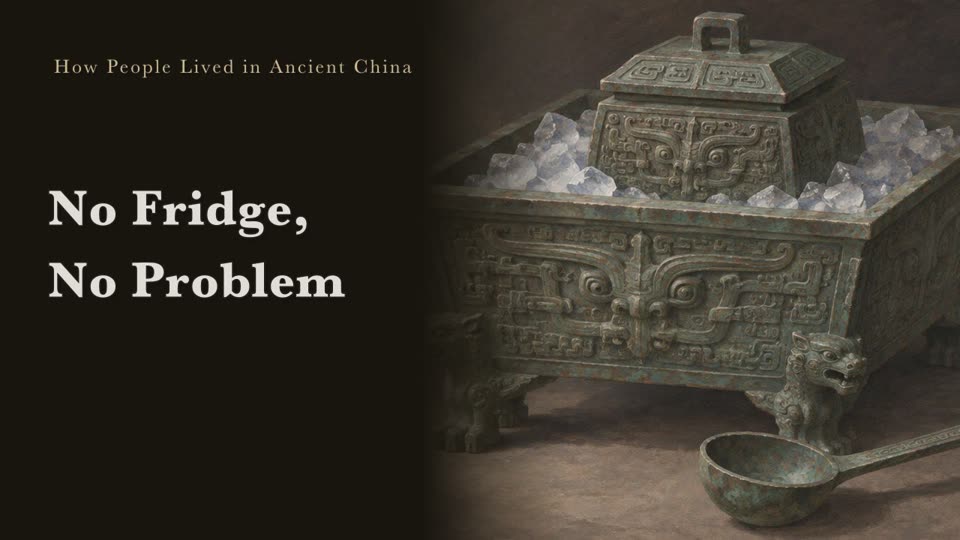
A Warring States “fridge”: the bronze jian-fou from Marquis Yi's tomb
What did an ancient “fridge” look like? One has actually survived. In 1978, the tomb of Marquis Yi of Zeng (early Warring States period) in Suizhou, Hubei, yielded a pair of bronze jian-fou vessels; today one is in the Hubei Provincial Museum and the other is in the National Museum of China. Each stands a little over 60 centimeters tall and weighs about 170 kilograms, and it's built like a box inside a box: a large square outer chest (the jian) holds a wine jar (the fou), with a gap left all the way around between the two. In summer you packed ice into that gap, and the wine in the middle slowly turned cold.
It works the same way as a picnic cooler today: ice on the outside, drinks on the inside.
Northern Song Bianjing: ice moved from the cellar to the night market
Could people in the Song dynasty get ice in summer? For a long time, ice belonged to the palace and the nobility. But by the Northern Song, it was starting to turn up on the street. In Dreams of Splendor of the Eastern Capital, Meng Yuanlao looks back on the Zhouqiao night market in Bianjing (today's Kaifeng) at the end of the Northern Song, and among the things sold there in summer, he lists:
「冰雪冷元子……甘草冰雪涼水、荔枝膏」
Ice-and-snow cold dumplings… licorice ice-and-snow water, lychee syrup
Meng Yuanlao, Dreams of Splendor of the Eastern Capital (東京夢華錄), Vol. 2, “The Zhouqiao Night Market” (州橋夜市)
What exactly these looked like, the book doesn't say — all we can see is the words “ice and snow” in their names. The point is that they were sold at a night market: set out by the roadside for anyone passing by. Ice had made its way from the cellar to the street.
Families without ice pickled their vegetables or buried them
Without ice, how did families keep vegetables through the winter? Most people never used ice in their whole lives. Essential Techniques for the Common People, by Jia Sixie of the Northern Wei, is all about how ordinary people farmed and made their food, and it teaches two methods.
The first is pickling. Pick good vegetables, tie them into bundles, wash them in brine that is “extremely salty,” and put them straight into a crock. The book makes a point of warning that if you wash them in fresh water first, they'll rot.
「作鹽水,令極鹹,於鹽水中洗菜,即內甕中。若先用淡水洗者,菹爛。」
Make brine, and make it extremely salty. Wash the vegetables in the brine and put them straight into the crock. If they are washed in fresh water first, the pickles will rot.
Jia Sixie, Essential Techniques for the Common People (齊民要術), Vol. 9, “Making Pickles and Storing Fresh Vegetables” (作菹、藏生菜法)
The second is burying. In the ninth or tenth month, dig a pit four or five chi (old Chinese feet) deep on the south side of a wall, where the sun shines. Lay the vegetables in, a layer of vegetables and then a layer of earth, and cover the top with a thick layer of straw. That way they keep through the whole winter, and when you take them out they are, in the book's words, “bright and fresh, no different from summer vegetables” — glossy and crisp, just like vegetables in summer.
The Qing Forbidden City: five ice cellars, 25,000 blocks
How much ice did the Qing-dynasty Forbidden City store? Cutting and storing ice went on all the way to the Qing dynasty. The Collected Statutes of the Great Qing says that every year, half a month after the winter solstice, workers were sent out to cut ice. They chose the cleanest, most solid ice and cut it into blocks one and a half chi square. The Forbidden City had five ice cellars, which were to hold 25,000 blocks. Four half-underground ice cellars still remain at the Palace Museum in Beijing today.
From the Book of Songs to the Qing, for more than two thousand years, people kept doing the same thing: storing up the cold while it was coldest, and saving it for when it was hottest.
Which parts shouldn't you take as certain?
- Traditional commentaries mostly read “the days of the second month” as the twelfth month of the Xia calendar. We only say “the coldest days” and don't pin it to a specific month.
- Reports on the height of the bronze jian-fou vary a little (about 61.5–63.2 cm), so we only say “a little over 60 centimeters.”
- Dreams of Splendor of the Eastern Capital was written from memory after the author left Bianjing, and it describes the city at the end of the Northern Song (about 1100–1127). The book doesn't say what the iced treats looked like, so we don't guess.
- The word rang in the original text of Essential Techniques for the Common People means grain stalks. In plain language we've called it straw or dry rice straw — close in meaning, but not exactly the same.
Sources
- Book of Songs (詩經), “Odes of Bin: The Seventh Month” (豳風・七月), final stanza (Chinese Wikisource / 維基文庫, checked 2026-11-11)
- Rites of Zhou (周禮), “Offices of Heaven: The Ice Officer” (天官冢宰・凌人); Zheng Xuan's commentary 「三之者,為消釋度也」 (“it is tripled to allow for melting”) (維基文庫, Annotations on the Rites of Zhou 周禮注疏, checked 2026-11-12)
- Bronze jian-fou from the tomb of Marquis Yi of Zeng: excavated in 1978 in Suizhou, Hubei (reports by The Paper / 澎湃新聞, CPPCC Online / 人民政協網, and Xinhua / 新華網)
- Meng Yuanlao, Dreams of Splendor of the Eastern Capital (東京夢華錄), Vol. 2, “The Zhouqiao Night Market” (州橋夜市) (維基文庫, checked 2026-11-11)
- Jia Sixie, Essential Techniques for the Common People (齊民要術), Vol. 9, “Making Pickles and Storing Fresh Vegetables, Chapter 88” (作菹、藏生菜法第八十八) (維基文庫, checked 2026-11-11)
- Collected Statutes of the Great Qing (欽定大清會典), Vol. 74, “Storing Ice” (藏冰) (維基文庫, checked 2026-11-12); Forbidden City ice cellars: China National Radio / 央廣網 report, 2016-09-29