How People Lived in Ancient China | Part 4
Winter without heating:
how did people keep warm?
In short: First, keep the wind out: in autumn, block every hole, plaster the door cracks with mud, and have the whole family squeeze into one room. Wealthy households paid attention to walls and floors. The Han empress's Pepper Chamber had walls plastered with pepper mixed into mud, while a Northern Wei temple lit fires outside and sent heat through channels in its foundation to warm the entire hall. Most families depended on a basin of charcoal they had to buy. Song people also used warming cages, hot-water bottles called tangpozi, and quilts made of paper.
Winter clothes had to be prepared by the ninth month, because winter could truly be unsurvivable
When did people begin preparing for winter? “The Seventh Month,” a poem in the “Airs of Bin” section of the Book of Songs, follows a farming family through an entire year. Its first line is:
「七月流火,九月授衣。」
In the seventh month the Fire Star sinks; in the ninth month, clothes are handed out.
Book of Songs (詩經), “Airs of Bin: The Seventh Month” (豳風・七月)
In the seventh month, the star called “Fire” begins to sink in the west, and the weather turns cool. By the ninth month, it is time to prepare winter clothes. Right after that comes a question:
「無衣無褐,何以卒歲?」
Without clothes, without coarse cloth, how will we last the year?
Book of Songs, “Airs of Bin: The Seventh Month”
No good clothes, not even rough cloth—how will we make it to the end of the year? This is more than rhetoric; it reflects the real problem of getting through winter without enough clothing. The same poem also says, “取彼狐貍,為公子裘”—“We take those foxes to make furs for the young lord.” In the same winter, some wore fox fur, while others did not even have rough cloth. The poem records both.
The first step in keeping warm: block holes, seal windows, and plaster door cracks
How could a house stay warm without heating? “The Seventh Month” also says:
「穹窒熏鼠,塞向墐戶。嗟我婦子,曰為改歲,入此室處。」
Stop up the holes and smoke out the rats; block the north window and plaster the door. Ah, my wife and children: the year is turning; come into this room to live.
Book of Songs, “Airs of Bin: The Seventh Month”
They blocked every hole in the house and drove out the rats with smoke; they stuffed the north-facing window and sealed the door cracks with mud. Then the head of the family told his wife and children that the new year was coming and they should move into this room. As the wind outside grew colder, the family sealed the last crack and squeezed into a single room. Two or three thousand years ago, the first step in keeping warm was keeping the wind out.
The Pepper Chamber: pepper mixed into mud and plastered on the walls
How did the imperial palace keep warm? The Han empress lived in a hall called the Pepper Chamber. The Sanfu Huangtu, a record of the palaces of Han Chang'an, explains the name this way:
「椒房殿,在未央宮,以椒和泥塗,取其溫而芬芳也。」
The Pepper Chamber is in Weiyang Palace. Its walls were plastered with pepper mixed into mud, for its warmth and fragrance.
Sanfu Huangtu (三輔黃圖), Vol. 3
They mixed Sichuan pepper into mud and plastered it on the walls, for warmth and fragrance. Whether pepper plaster really made a room warmer is hard to prove today. But this is what the Sanfu Huangtu records: at least this account describes it as warm and fragrant.
Underfloor heating fifteen hundred years ago
Did ancient people have a way to warm an entire building? In the Northern Wei, Li Daoyuan wrote in the Commentary on the Water Classic about Guanji Temple in the north. Its great hall could seat a thousand monks, and its foundation was built like this:
「基內疏通,枝經脈散。基側室外,四出爨火,炎勢內流,一堂盡溫。」
Inside the foundation are open channels, branching like veins. Outside, at the base of the walls, fires are lit on all four sides; the heat flows inward, and the whole hall is warm.
Li Daoyuan, Commentary on the Water Classic (酈道元《水經注》), Vol. 14, “Baoqiu River” (鮑丘水)
Channels spread through the foundation like branches or blood vessels. People lit fires outside, and the heat flowed through the channels, warming the entire hall. Li also explained why: the place was bitterly cold, most monks were poor, and donors worried that the cold would keep them from practicing. It was not only clever design. It was someone worrying that others would be cold.
The person who made the charcoal was the coldest
What did most households depend on in winter? A basin of charcoal that had to be bought. Bai Juyi's “The Old Charcoal Seller” describes an old man who burned charcoal in the mountains:
「可憐身上衣正單,心憂炭賤願天寒。」
Pitiful—his clothes are thin, yet he worries charcoal is cheap and wishes for colder weather.
Bai Juyi, “The Old Charcoal Seller” (白居易〈賣炭翁〉)
His clothes were so thin, yet he worried that charcoal would fetch too little, so he hoped the weather would turn colder. A man about to freeze was hoping for colder weather. After a foot of snow fell, he drove his ox cart into the city at dawn. Palace agents took the entire cartload and left only:
「半匹紅紗一丈綾,繫向牛頭充炭直。」
Half a bolt of red gauze and ten feet of silk, tied to the ox's head as payment for the charcoal.
Bai Juyi, “The Old Charcoal Seller”
Half a bolt of red gauze and a length of silk, hung on the ox's head—that was counted as payment for the charcoal.
On the first day of the tenth month, the Northern Song capital held warming-stove gatherings
On what day did people begin using their stoves? Dreams of Splendor of the Eastern Capital says that every year, on the first day of the tenth month:
「有司進暖爐炭。民間皆置酒作暖爐會也。」
The officials present charcoal for the warming stoves. Among the people, everyone sets out wine and holds a warming-stove gathering.
Meng Yuanlao, Dreams of Splendor of the Eastern Capital (孟元老《東京夢華錄》), Vol. 9, “The First Day of the Tenth Month”
Officials sent stove charcoal into the palace, while ordinary people held a “warming-stove gathering.” The first day of the tenth lunar month falls roughly between late October and late November today. Households across the city held these gatherings that day, as if welcoming the season of stove fires together. Winter did not begin secretly for one person. Everyone agreed to get warm together from that day on.
The warming cage: a bamboo cover over a brazier
A xunlong, or warming cage, was a woven bamboo cover placed over a brazier. Clothes and quilts could be draped over it to warm and dry, and people could lean against it for warmth. Bai Juyi wrote of a palace lady who had lost the emperor's favor and could not sleep:
「紅顏未老恩先斷,斜倚熏籠坐到明。」
Her beauty not yet faded, his favor already gone; leaning on the warming cage, she sits till dawn.
Bai Juyi, “Palace Poem” (白居易〈後宮詞〉)
She was not yet old, but the emperor's affection was already gone. She leaned against the warming cage until daybreak. All night, her only companion was the little fire beneath it.
Tangpozi: a nine-hundred-year-old hot-water bottle
How did people warm their feet in bed? Song people had the tangpozi, also called a “foot granny”: a flat bottle filled with hot water before bed and tucked under the covers by the feet. Huang Tingjian ended “A Playful Poem on a Foot-Warming Bottle” with:
「千錢買腳婆,夜夜睡天明。」
A thousand coins buys a foot granny; every night I sleep till dawn.
Huang Tingjian, “A Playful Poem on a Foot-Warming Bottle” (黃庭堅〈戲詠暖足瓶〉)
Spend a thousand coins on a foot warmer, and sleep until morning every night. The hot-water bottle you may have used as a child works in a similar way, and the idea was already recorded in the Song dynasty.
A paper quilt, softer than silk floss
Were there really quilts made of paper? When a friend sent Lu You a paper quilt, he wrote a poem of thanks:
「紙被圍身度雪天,白於狐腋軟於綿。」
Wrapped in a paper quilt, I pass the snowy days; whiter than fox fur, softer than silk floss.
Lu You, “Thanks to Zhu Yuanhui for Sending a Paper Quilt” (陸游〈謝朱元晦寄紙被〉)
He wrapped himself in the paper quilt to get through snowy days. It was whiter than the fur beneath a fox's foreleg and softer than silk floss.
On a night when the quilt was cold as iron, Du Fu thought of others
Of course, there were also nights when quilts gave no warmth. In Chengdu, an autumn wind tore the roof from Du Fu's thatched hut, and rain fell that night:
「布衾多年冷似鐵。」「安得廣廈千萬間,大庇天下寒士俱歡顏。」
My cloth quilt, years old, is cold as iron. If only there were ten thousand great houses to shelter all the cold scholars under heaven, all with smiling faces.
Du Fu, “My Thatched Roof Is Ruined by the Autumn Wind” (杜甫〈茅屋為秋風所破歌〉)
His old cloth quilt was cold as iron. Yet on that cold and wet night he wished for ten thousand great houses where everyone suffering from the cold could live. Decades later, Bai Juyi put on a newly made padded robe and suddenly sat up in the middle of the night:
「安得萬里裘,蓋裹周四垠。穩暖皆如我,天下無寒人。」
If only I had a robe ten thousand li wide, to cover every corner of the land, so all could be as snug as I—then no one under heaven would be cold.
Bai Juyi, “A Newly Made Cloth Robe” (白居易〈新製布裘〉)
One poet's roof was broken; the other had just put on new clothes. Yet both thought of the same thing.
A twenty-character invitation: the little red-clay stove
How warm can one winter-night invitation be? On an evening when snow seemed near, Bai Juyi wrote twenty characters to his friend Liu Nineteen:
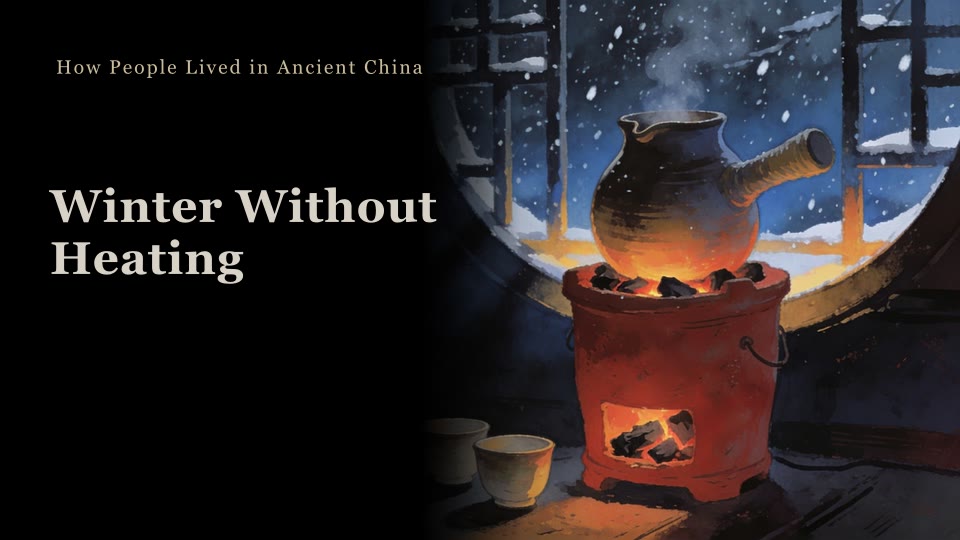
「綠螘新醅酒,紅泥小火爐。晚來天欲雪,能飲一杯無?」
Green froth on new-brewed wine, a little stove of red clay. Evening comes, snow is near—will you have a cup with me?
Bai Juyi, “A Question for Liu Nineteen” (白居易〈問劉十九〉)
Green froth floated on the newly brewed wine, and the little red-clay stove was already lit. It looked like snow that evening—could his friend come for a drink? He did not say how cold it was or how lonely he felt. He simply said: I have a fire and wine. Would you like to come?
Now, a press of a button brings warmth
For a very long time, a little winter warmth was mud plastered over door cracks, fire beneath the floor, a cart of charcoal hauled down from the mountains, or a bottle of hot water under the covers. And when these books write about warmth, it is almost never about one person alone: a family squeezes into one room; someone builds a hall for monks afraid of the cold; a whole city holds its warming-stove gatherings on the same day; Du Fu thinks of others in his broken hut; Bai Juyi lights his fire and asks a friend to come. If it is a little cold tonight, you could send someone a message and ask whether they have eaten.
Which parts shouldn't you take as certain?
- The “Fire” in “the Fire Star sinks in the seventh month” is usually understood as the Great Fire Star, Antares, sinking in the west. “Clothes are handed out in the ninth month” only says it is time to prepare winter clothing; it does not identify who gives clothing to whom.
- Reading xiang as a north-facing window and jin as plastering with mud follows traditional commentaries. “Two or three thousand years ago” is an approximation.
- Whether pepper mixed into wall plaster could truly warm the Pepper Chamber is difficult to prove today. We only report what the Sanfu Huangtu says.
- Guanji Temple was in the area of ancient Tuyin County; here we say only “the north.” “Fifteen hundred years ago” is approximate, and “underfloor heating” is an analogy.
- Different editions phrase the weight of the “cartload of charcoal” in “The Old Charcoal Seller” differently, so we only paraphrase it. In some editions of Dreams of Splendor of the Eastern Capital, the characters printed as “置酒” differ.
- The usual description of a tangpozi as a flat bottle filled with hot water and placed by the feet is not supported here by a separate quotation. Another version of Lu You's line has “暖於綿” (“warmer than silk floss”) instead of “軟於綿” (“softer than silk floss”).
- The first day of the tenth lunar month can fall from late October to late November in the Gregorian calendar. The exact date depends on each year's calendar.
Sources
- Book of Songs (詩經), “Airs of Bin: The Seventh Month” (豳風・七月) (Chinese Wikisource)
- Sanfu Huangtu (三輔黃圖), Vol. 3 (Chinese Wikisource)
- Li Daoyuan, Commentary on the Water Classic (酈道元《水經注》), Vol. 14, “Baoqiu River” (鮑丘水) (Chinese Wikisource)
- Bai Juyi, “The Old Charcoal Seller” (白居易〈賣炭翁〉) (Chinese Wikisource)
- Meng Yuanlao, Dreams of Splendor of the Eastern Capital (孟元老《東京夢華錄》), Vol. 9, “The First Day of the Tenth Month” (Chinese Wikisource)
- Bai Juyi, “Palace Poem” (白居易〈後宮詞〉) (Chinese Wikisource, Classified Anthology of Tang Poetry, Vol. 52)
- Huang Tingjian, “A Playful Poem on a Foot-Warming Bottle” (黃庭堅〈戲詠暖足瓶〉) (Chinese Wikisource, appendix to Shilin Guangji; Imperial Encyclopaedia, Artificers and Crafts, Hot-Water Bottles)
- Lu You, “Thanks to Zhu Yuanhui for Sending a Paper Quilt” (陸游〈謝朱元晦寄紙被〉) (Chinese Wikisource, Imperial Encyclopaedia, Artificers and Crafts)
- Du Fu, “My Thatched Roof Is Ruined by the Autumn Wind” (杜甫〈茅屋為秋風所破歌〉) (Chinese Wikisource)
- Bai Juyi, “A Newly Made Cloth Robe” (白居易〈新製布裘〉) (Chinese Wikisource)
- Bai Juyi, “A Question for Liu Nineteen” (白居易〈問劉十九〉) (Chinese Wikisource)